Labels

Wednesday, 30 October 2013

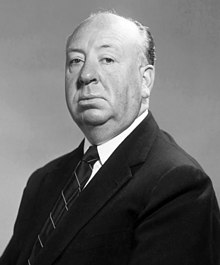
Alfred Hitchcock


Alfred Joseph Hitchcock is considered as one of the greatest directors of thrillers in the world. His work drastically influenced the film industry today and made the thriller genre a huge success.


Born  on the 13th of August 1899 in Leytonstone England, Hitchcock was raised a strict Catholic and had a pretty regular upbringing. He managed to secure his first proper job as an estimator for the Henley Telegraph and Cable Company.This is when his interest in cinematography began. He started to frequently visit the cinema and even began reading US trade journals. In 1920 Hitchcock managed to secure a job as a title designer for Lasky's new studio in London. Three years later Hitchcock was given his first shot at directing the remainder of the film "Always Tell Your Wife" as the original director fell ill during filming. Having impressed the studio chiefs, Hitchcock was given the opportunity to start directing the film "number 13". However this film was not completed as the studio closed down. After this failed attempt Hitchcock did not give up his pursuit of success. In 1925 he directed "the sound garden". This film was a great success and finally allowed him to start his career.

Alfred then went on to create over fifty films over a career spanning six decades. Because distinctive and recognizable directorial style he gained the status of a cultural icon throughout the world. Without Hitchcocks contributions to the film industry, modern cinema would not be what it is today.

                 
Complete List Of Hitchcocks Films
Number 13 (1922) (unfinished)
Always Tell Your Wife (1923) (unfinished)
The Mountain Eagle (1926)
The Lodger: A Story of the London Fog (1927)        
The Ring (1927)
Downhill (1927)
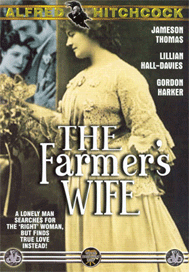
The Farmer's Wife (1928)
Easy Virtue (1928)
Champagne (1928)
Blackmail (1929)

The Manxman (1929)

Juno and the Paycock (1930)
Murder! (1930)
Elstree Calling (1930)
The Skin Game (1931)
Mary (1931)
Rich and Strange (1931)
Number Seventeen (1932)
Waltzes from Vienna (1933)
The Man Who Knew Too Much (1934)
The 39 Steps (1935)
Secret Agent (1936)
Sabotage (1936)
Young and Innocent (1937)
The Lady Vanishes (1938)
Jamaica Inn (1939)

Rebecca (1940)
Foreign Correspondent (1940)
Mr. & Mrs. Smith (1941)
Suspicion (1941)
Saboteur (1942)
Shadow of a Doubt (1943)
Lifeboat (1944)
Aventure Malgache (1944)
Bon Voyage (1944)
Spellbound (1945)
Notorious (1946)
The Paradine Case (1947)
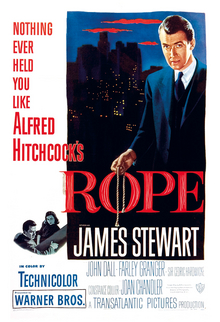
Rope (1948)
Under Capricorn (1949)

Stage Fright (1950)
Strangers on a Train (1951)
I Confess (1953)
Dial M for Murder (1954)
Rear Window (1954)
To Catch a Thief (1955)
The Trouble with Harry (1955)
The Man Who Knew Too Much (1956)
The Wrong Man (1956)
Vertigo (1958)
North by Northwest (1959)

Psycho (1960)
The Birds (1963)
Marnie (1964)
Torn Curtain (1966)
Topaz (1969)

Frenzy (1972)
Family Plot (1976)
The Short Night (1979) (cancelled)


Sound Excercise

Tuesday, 29 October 2013

Sound

In any film sound is majorly important. There are two types of sound: digetic and non digetic.

Digetic Sound
digetic sound refers to sound that you would typically hear within the world of narrative. Examples of digetic sound are dialogue, sound effects and music. However music is only digetic sound when it comes from a source within the scene; the source of the music doesn't have to be visible but it has to be expected to be used where it is heard (for example if a scene is filmed in a club/bar the source of the music may not be visible but hearing music in that setting is a norm).

Non Digetic Sound
Non digetic sound refers to sound that are not heard within film; basically everything outside the world of narrative. Examples of digetic sound are voice overs, captions, titles/subtitles and soundtracks.

As well as there being Digetic and non digetic there is also onscreen and off screen sound.

Onscreen And Off screen Sound
Onscreen sound is sound that is relative to what is shown in the shot e.g a telephone ringing where as off screen sound is sound that has no relation to what is happening in the shot. The most common use of off screen sound is music.

Parallel
Parallel sound is when the sound matches the action.
Contrapuntal
Contrapuntal sound is when the sound does not match the action.

Sound Bridge
A sound bridge helps create a smooth transition between two different scenes.


Friday, 25 October 2013

Psycho

"Psycho" is considered one of Hitchcocks greatest creations. The story starts with an office worker from Phoenix who meets her lover Sam during her lunch break. They want to get married but Sam cant afford to as he has to pay alimony to his ex wife. One afternoon at work she is trusted by her boss to put $40,000 in a One afternoon Marion is trusted to deliver $40,000 into a bank account. The money is the macguffin of this narrative. However the money is just too tempting so she decides to steal the money and start a new life. 
Whilst  on the run she gets caught in a storm which prevents her from going further so she decides to stay over night at the Bates Hotel. The motel is managed by a  young man called Nathan who appears to be completely under his mothers control.


The red herring of this film is brilliantly unique as the audience believe that the film is centered around money but really its about something more sinister. Because of this the murder of who appears to the protagonist shocks the audience. It appears that Norman's mother committed the murder however later on we learn that this was another red herring. This murder scene is seen as one of the most iconic scenes in cinema history. Throughout this scene an array of editing techniques is used such as fast paced editing and an iconic graphic match. 

The use of music throughout this films is archetypal. This is because whenever something major is about to happen the music starts which alerts the audience and builds suspense. 

Like the car scene and shower scene, fast paced action occurs frequently through the film. Another example is the staircase scene. After learning that Marian is missing her sister calls Sam and a detective. The detectives search leads him to the Bates Hotel where he continues with his investigation. Whilst there his investigation leads him to Norman's house where his mother supposedly lives. Once inside the house he walks up the stairs when suddenly he is attacked and repeatedly stabbed.


After not hearing from the detective Marion's sister and Sam head to the Bates motel where they trick Norman into thinking they're a couple. Whilst there they discover Normans mother died years ago after apparently murdering her partner. After murdering Normans stepfather she apparently committed suicide.This leaves the audience with many questions. Did Normans mother really kill herself? Is she really dead? is it her skeleton in the basement? No matter what the audience thought no one could predict that it was Norman Bates who murdered the detective and Marian and maybe even his own parents. It turns out that Norman is suffering from dissociative identity disorder. Norman developed this disorder as a result of severe emotional abuse from his mother during his childhood. After murdering his mother he assumed her personality to repress his awareness of her death and his feelings of guilt. Whenever his mother would take over completely he would kill anyone that threatened to break the illusion. 


Wednesday, 23 October 2013

Suspense And Shock

In thriller's suspense and shock is a key element. But what is suspense and shock and how is it used?

Shock
Shock in film is a sudden upsetting or surprising event/experience that causes an emotional response within the audience. Typical responses from the audience during a shocking scene are surprise, disbelief, fear and sometimes even relief. Shock is a key convention of a thriller as


Suspense
Suspense is a frame of mind in which a person feels uncertain about what is going to happen resulting in anxiousness and sometimes even fear. Suspense is majorly important within films of the thriller genre as it manipulates the audience into feelings of excitement and and tension which transforms into a form of anticipation keeping the audience on "the edge of their seat".


Saturday, 19 October 2013

What Is A MaGuffin?

A maguffin is an something that is desired by either the antagonist or the protagonist. Usually as an audience we are not informed by narrative of why the maguffin has such a significant importance. A maguffin is usually an object but it can also be a place, person or even an emotion felt by the antagonist. The maguffin acts as a motivator but is usually seen as an unimportant part of the plot.

Examples of maguffin's in film

Throughout film history maguffins have played a major role in creating the best film possible. If the maguffin does not match the rest of the film the the audience may find the film unrealistic.

Lord Of The Rings
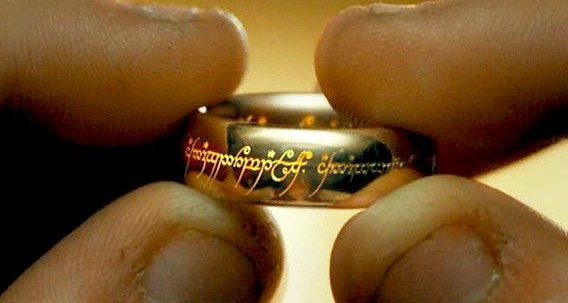
A good example of a maguffin is the ring in Peter Jackson's "Lord Of The Rings". In Lord Of The Rings Frodo is sent on a dangerous journey to destroy the ring in mount doom as it has the  ability to control all the other Rings of Power which could destroy Middle-earth. To the audience, although we can clearly see that the ring is powerful we seem to focus more on Frodo's actual journey rather than the ring.


Mission Impossible 3
Another good example is the rabbits foot in mission impossible 3. In the film weapons dealer Owen Davian wants the rabbits foot and it's up to Hunt to get it for him or else his fiancee Julia will be brutily murdered. This rabbits foot is unimportant to the audience and the protagonist but seems majorly important to the antagonist. This rabbits foot drives the whole of the plot. 


Thursday, 17 October 2013

Rules And Conventions Of A Thriller

There are many different conventions used throughout a thriller such as:
  • camera movement
  • close up/ long shot framing
  • low/high angle shots
  • jump cuts
  • digetic sound
  • red herrings 
Camera movement
tracking and pan shots are extremely common at the beginning of thrillers. This is done to guide the interest of the audience to a certain person/group.

Close up/long shot framing
close up framing is one of the most popular types of framing in a thriller. It is usually used to create suspense and make the scene appear more dramatic. Another frame type used frequently in thrillers is long shot framing. Long shot framing is used to establish the scene.

Low/high angle shots
Low angle and high angle shots are very common in thrillers. Low angle shots are used to make a character seem weak and vulnerable; completely defenseless. Where as high angle shots are usually used to express power and strength.  These shots are usually found a the point in which the antagonist has gained control and power over the protagonist. An example of this can be found in the crop duster scene in Alfred Hitchcock's "north by north west" Our protagonist Richard Thornhill is shown in many low angle shots to represent is vulnerability where as in contrast the crop duster is shown in many high angle shots to represent the antagonists power. 


Jumpcuts
a jump cut is an abrupt transition between one scene to another and are extremely common in thrillers. This is because they go smoothly with the fast paced plot of a thriller. Jump cuts are used to link two scenes together. Good examples of films with good jump cut is Guy Richie's "Snatch" and Stanley Kubrick's " A Space Odyssey". 


Digetic Sound
Digetic sound is used throughout thrillers as it is one of the most effective ways in which they can create suspense. Digetic sound such as the soundtrack plays a key role in most thrillers as it tells the audience how to react/feel without actually telling them. It also helps establish the scene.

Red Herrings
Red herrings are a typical convention of a thriller as they keep the audience in suspense and on the edge of their seats. A good example of a red herring is in the scene where we find out the Bourne actually worked for the people that are trying to kill him in Doug Limen's " The Bourne Identity" 


Friday, 11 October 2013

The Birds


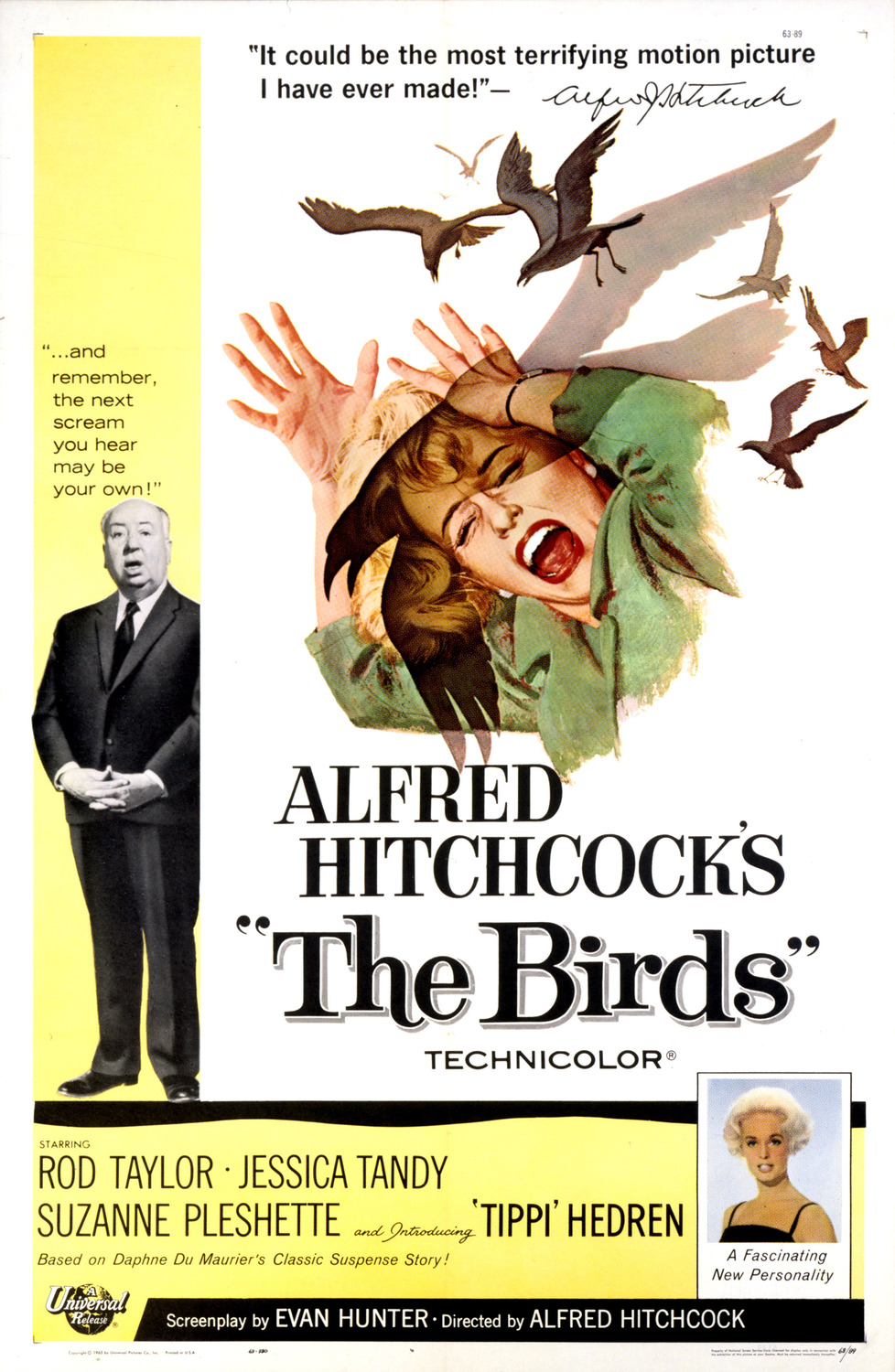
The birds by Alfred Hitchcock is about a young wealthy woman called Melanie Daniels (Tippie Hedren) who travels to California to pursuit a potential love interest after a flirty exchange in a bird shop in San Francisco. At the start the audience is mislead as it appears that the film has a romance driven plot. However this drastically changes when birds start attacking the whole town starting with Melanie Daniels.


At first the attack is put down to pure coincidence but that proves not to be the case when a flock of seagulls attack a childrens party. 


After this attack our protagonist starts to warn everyone but they just shrug it off.  But the birds are relentless. They're on a revenge fueled attacking spree first murdering an old man by breaking into his home and then attacking the school.


Hitchcock uses dramatic irony  in the school yard scene when the birds are seen behind Melanie. The amount of birds gradually increases but unlike the audience she is unaware of what is happening. Throughout  this scene the tension and suspense is high as the audience are waiting for something to happen.


 Alfred Hitchcock also uses deliberate irony when there is a Ornithologists who loves birds sitting near another character who orders chicken. In this scene the birds attack again. We see them attack from a high camera angle where the birds attack there is a very high camera angle. This makes the birds look superior to the humans as it makes them look weak and defenseless. This can be described as "The gaze of a pitiless god who cannot be bothered to intervene". 


The last attack scene also creates a lot of suspense and tension. As she is walking up the stairs the audience are on the edge of their seats just waiting for something to happen. This scene took a week to shoot. as the birds were attached to Tippie's clothes using long nylon threads so they were unable to get away. As a result of this she was actually cut in the face by one of the birds. 


At the end of this film Hitchcock doesnt use the typical "The End" slide. He did this because he wanted to suggest that there will be no end to the birds terrifying attacks.

Thriller Conventions

The birds follows a large percentage of the typical conventions found in thrillers.  For example our Protagonist played by Tippie Hedrin is an ordinary unprepared hero and has the fight for her life. Other typical conventions he used are: dramatic irony and fast paced scenes.


Monday, 7 October 2013

Camera Excercise


In our past few lessons of media we have filmed and edited a short film to practice our camera skills. In this film we had to include a wide range of camera shots to show that we understood them and when it is most appropriate to use them.


Our Story line 

The story that my group and me were trying to tell was about a lost object. The object was unknown to the audience as it was only referred to as “the stuff”.  Although our story line was rather simplistic, I feel that by introducing a sense of mystery the audience would be intrigued and want to continue watching.


Camera

The only shot type did we did not use was a crane shot as it is a rather tricky shot to create and we only had a short amount of time.The first shot we used was a point of view. We chose to use a p.o.v shot first as it creates a personal connection between the audience and the protagonist. It does this by allowing the audience to see through the protagonist’s eyes.

 The second shot we used was a medium shot. This was used to show our protagonist walking into the room. I feel that this was the most effective shot to use to show this action as it clearly shows her upper body language that is very serious. 


The next shot was an extreme close up of our protagonist’s feet, which lead up to a tilt shot/low angle. The low angle of our tilt shot made our protagonist appear powerful. 

Next we used a medium shot. We used a medium shot of the classroom to set the scene. The clock that can be seen during this shot also helps set the scene as it tells the audience that the film is starting in the morning. 

After this medium shot we used a tracking medium shot (of our protagonist walking into the room)  that lead into an extreme close up of our protagonists eyes. We chose to use this shot as it shows her serious body language. After this we used a pan shot of the whole classroom to establish the setting even more.


After repeating a few more shots we used a long shot of our protagonist walking towards an unknown acquaintance. We decided to use this shot as it is a good way to show that the protagonist and the acquaintance know each other. 


The next two shots used were both over the shoulder shots. We chose to use this as it was the best way to show the two characters engaging in conversation. After this shot we used a rollover shot. We chose to use this as it is extremely effective in showing the shock of our protagonists face when she hears that the "stuff" is lost. 


A high angle shot was used next. We chose to use this as not only did it make our main character look vulnerable but it also showed her staggering to the desk better than any other shot would. The last shot we used was a slightly high angle medium shot. We chose this as it shows our protagonists frustration and anger in the best possible way. 

Strengths and weaknesses

Although in our group we were all pretty pleased with what we produced we did have some weaknesses. An example of a weakness is that we did not use a crane shot. This would of made our film better as it would have shown we know the best way in which to use one. Another weakness is that it was very short. If we were to recreate this film i would aim to make it around 2 minutes long as it wasn't even a minute long. The last major weakness i can find is with the low angle tilt shot. When tilting upwards i struggled with keeping the camera still which resulted in the tilt not being as smooth as it could have been. Even though we had many weaknesses i believe our film had many strengths too. I particularly feel that our point of view shot and our over the shoulder shot were very effective as they look rather professional and they were used in the right situation.

Saturday, 5 October 2013

Cinematography

Micro elements
During the creation of a film the micro elements need to be carefully considered. The micro elements are the shot types and camera movements.


Close Up


A close up is when an object takes up most of the frame. In films close ups are usually used to show a characters emotion or to give the audience some kind of hint or clue by using a mundane object.

Extreme Close Up


An extreme close up is when a certain part of an object/person takes up the majority of the frame. It is used to show extreme detail. As this shot is too close to show general reactions or emotion it is only really used to show detail that is either important to the plot or to create a certain effect/

Medium Shot


A medium shot is when the person/object takes up a large percentage of the frame but some background can still be seen. This is commonly used to show a character talking. A reason this shot is so effective when showing a character conversation as it is roughly the approximation of how you would see a person if you were having a conversation with them.

Long Shot


A long shot when referring to a person/object is when the person/object takes up almost the full frame height. In other situations a long shot is simply a wide shot of a whole scene, where  the subjects are placed  in their environment.

Point Of View


A point of view shot is when the shot shows a view from a subjects perspective. This shot is used to create a personal connection between the audience and the subject as its like we are seeing the scene through their eyes.

Low Angle


A low angle shot shows the subject from below. This shot is usually used to establish power and dominance.

High Angle


A high angle shows the subject from above; the camera is angled down towards the subject. This shot is used to make the subject appear  less powerful, vulnerable and even submissive.


Over The Shoulder


An over the shoulder shot is framed from behind a person who is looking at the subject. The person facing the subject should usually occupy about 1/3 of the frame. This shot is used usually in a conversation and is similar to a POV shot as it helps create a personal connection between the audience and the subjects as you can see what they see.  In an over the shoulder shot it is common to cut between the subjects during a conversation, alternating the view between the different speakers.


Establishing Shot


An establishing shot is a shot that establishes the setting. They are usually used during the opening scenes of a film and are usually extra long shots.

Crane Shot


Tilt


Pan


A pan shot is a horizontal camera movement in which the camera moves left and right about a central axis. This is a swiveling movement which is able to happen as the camera is  in a fixed location on a tripod. This shot is usually used 

Tracking Shot 


Steadicam

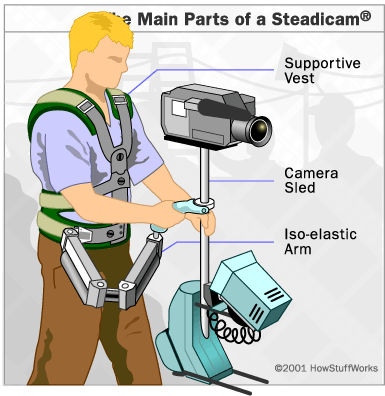
In 1975 The Steadicam was invented by cameraman Garrett Brown. It is a type of camera stabilizer that mechanically isolates the camera from the operator's movement which allows a smooth shot even when moving. A good example of where a steadicam has been used in film is the chase scene in the shinning.