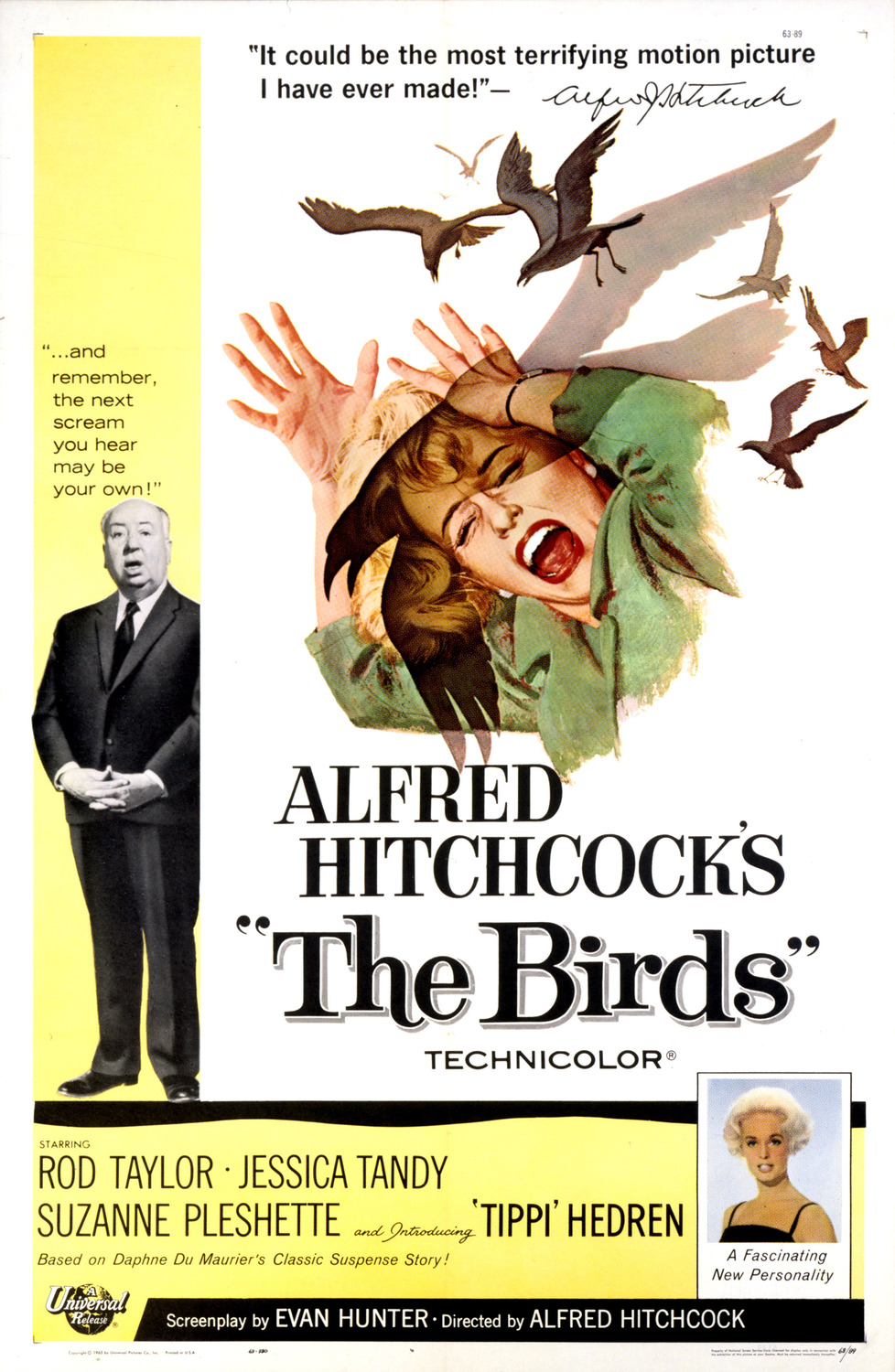
At first the attack is put down to pure coincidence but that proves not to be the case when a flock of seagulls attack a childrens party.
After this attack our protagonist starts to warn everyone but they just shrug it off. But the birds are relentless. They're on a revenge fueled attacking spree first murdering an old man by breaking into his home and then attacking the school.
Hitchcock uses dramatic irony in the school yard scene when the birds are seen behind Melanie. The amount of birds gradually increases but unlike the audience she is unaware of what is happening. Throughout this scene the tension and suspense is high as the audience are waiting for something to happen.
Alfred Hitchcock also uses deliberate irony when there is a Ornithologists who loves birds sitting near another character who orders chicken. In this scene the birds attack again. We see them attack from a high camera angle where the birds attack there is a very high camera angle. This makes the birds look superior to the humans as it makes them look weak and defenseless. This can be described as "The gaze of a pitiless god who cannot be bothered to intervene".
The last attack scene also creates a lot of suspense and tension. As she is walking up the stairs the audience are on the edge of their seats just waiting for something to happen. This scene took a week to shoot. as the birds were attached to Tippie's clothes using long nylon threads so they were unable to get away. As a result of this she was actually cut in the face by one of the birds.
At the end of this film Hitchcock doesnt use the typical "The End" slide. He did this because he wanted to suggest that there will be no end to the birds terrifying attacks.
Thriller Conventions
The birds follows a large percentage of the typical conventions found in thrillers. For example our Protagonist played by Tippie Hedrin is an ordinary unprepared hero and has the fight for her life. Other typical conventions he used are: dramatic irony and fast paced scenes.

No comments:
Post a Comment